
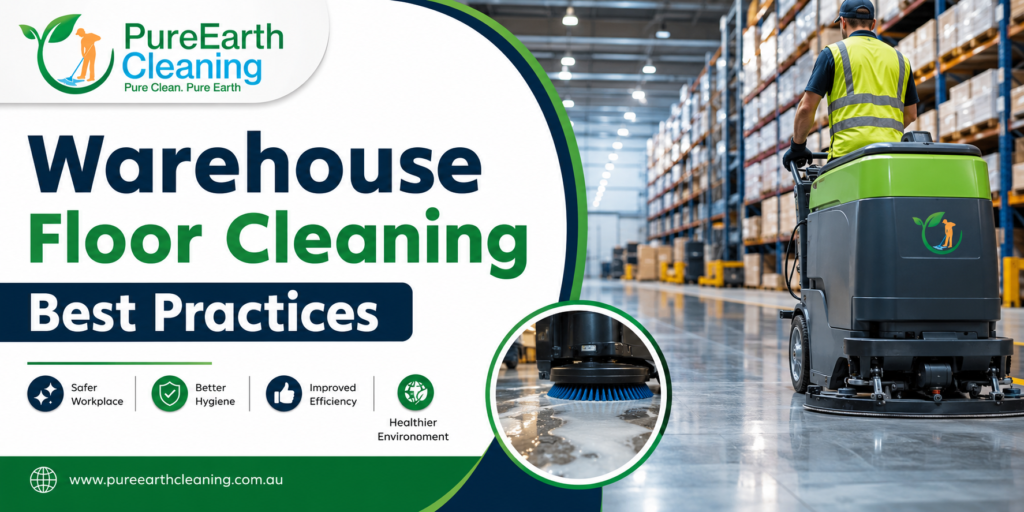
Best practices for warehouse floor cleaning include consolidating daily debris and spill cleanup, machine cleaning, targeted stain treatment, and professional deep cleaning. Warehouse floors are subjected to forklift traffic, pallet movement, dust, oil, tire marks, packaging debris, and continual employee movement. Without a formal maintenance program, these contaminants can accumulate quickly, worsening floor maintenance and posing a workplace safety risk.
A warehouse floor can appear fairly neat yet still contain hidden dirt in textured concrete, corners and loading zones, and high-traffic paths. The correct solution, then, is not to sweep here and there.
Depending on traffic levels, the type of floor material used in the warehouse, the nature of operational activities, and the risk of contamination, businesses should follow a scheduled cleaning plan. Accumulation beyond the capability of regular maintenance can then be addressed with professional commercial floor cleaning.
Why Warehouse Floor Cleaning Requires a Structured Approach
Compared with office or retail premises flooring, warehouse flooring is very different. Outdoor contamination, heavy machinery, goods movement, and industrial activities create a cleaning challenge that demands proper equipment and routine maintenance.
Heavy Machinery Creates Constant Floor Wear
The movement of forklifts, pallet jacks, and trolleys, among others, keeps the floors of warehouses. Tire prints, dusty areas, oil residue and set grime can slowly form along popular routes and loading areas.
Outdoor Contaminants Enter Continuously
Dust, dirt, moisture, leaves, and other outside debris can seep in through loading docks and frequently used doors. Contaminants spread further into the facility unless they are removed regularly.
Spills Require Immediate Attention
Liquids, grease, oil, and chemicals, as well as damaged products, can create tricky stains and even slippery floors. Proper industrial floor cleaning must clear spills quickly rather than leaving traces behind.
Large Floor Areas Need Appropriate Equipment
Moisture-wiping thousands of square meters every day is not normally an effective maintenance approach. Specialized equipment and commercial floor scrubbers yield more uniform results in large warehouses.
Daily Warehouse Floor Cleaning Best Practices
Daily maintenance prevents loose debris and fresh contamination from becoming more challenging cleaning issues. The frequency to be used ought to be based on the activity in the warehouse as opposed to using the same routinization across all the facilities.
Sweep High-Traffic Routes Regularly
Pay special attention to forklift lanes, picking areas, packing areas, loading docks, and main walkways. Regular sweeping will eliminate the spread of loose dirt and packaging junks around the warehouse.
Clean Spills as Soon as Possible
Address oil, liquid, food, and other spills as soon as possible, using cleaning products appropriate to the contaminant and the flooring material. Delays in treatment can make stains much harder to remove.
Keep Loading Areas Clean
Docking often collects dirt on cars, pallets, packing, and the surrounding area. Daily cleaning of warehouse facilities can include these areas to prevent contamination of the entire building.
Remove Packaging Debris
Do not leave miscellaneous items in work areas, such as plastic wrapping, cardboard pieces, or pallet fragments. Regular cleaning enhances aesthetics and eliminates debris such as dust around shelf units and equipment.
Best Practices for Deep Cleaning Warehouse Floors
Normal sweeping works on loose materials; however, deep cleaning must be performed on materials that are attached or embedded in the floor surface and that people cannot remove with normal sweeping.
Use Machine Scrubbing for Large Areas
Commercial floor scrubbing of a warehouse floor involves using professional machinery to wash and scrub the floor and remove deep-seated dirt. It offers much more consistent coverage than manual mopping.
Match Cleaning Products to the Floor
The concrete, epoxy, sealed, and other flooring materials in the warehousing sector require varying levels of maintenance. Using the wrong chemicals can compromise coatings or leave residues, so cleaning products must always match the floor specification.
Degrease Contaminated Areas
Machinery, automotive or industrial material warehouses can develop oil and grease. These areas can be targeted with the aid of targeted degreasing, whereby the entire warehouse is not unnecessarily treated with the harsh products.
Pay Attention to Edges and Corners
Major cleaning machinery may not be able to traverse under shelving, around columns, along a wall or even into a corner. Professional deep cleaning in these areas must be handled separately.
Warehouse Areas That Need Extra Cleaning Attention
Not all items of a warehouse get dirty equally. Breaking down the facility into cleaning areas enables the concentration of resources on the contamination and traffic hotspots.
Loading Docks
Vehicle-related dirt, outside contaminants, pallet debris and regular foot traffic are deposited in the loading areas. Such areas normally need to be cleaned more often than low-traffic storage areas.
Forklift Routes
Forklift activity causes evident traffic lines and tyre tracks and ingrained dirt. This can be avoided by frequently checking and washing machines to prevent permanent discoloration.
Picking and Packing Areas
Employees work long hours in picking and packing areas, and cardboard, tape, wrapping materials, dust, and product debris may be present at the end of every shift.
Storage and Racking Areas
The area of flooring under and around warehouse racking may easily be ignored during normal cleaning. Planned full-scale cleaning allows dust and debris to stay uncleaned over a long period of time.
Staff and Pedestrian Walkways
Striped paths must also be kept clear of dirt and pollution. Clean pedestrian walkways also help keep warehouse surroundings more organized.
Recommended Warehouse Floor Cleaning Schedule
There is no universal cleaning frequency for every warehouse. Businesses should adjust their schedule according to traffic, operational hours, flooring material, and the type of products handled.
| Frequency | Recommended Floor Cleaning |
| Daily | Sweep traffic lanes and remove debris. |
| As Required | Clean spills and contamination immediately. |
| Weekly | Detailed cleaning of corners and loading areas |
| Monthly | Machine scrub high-traffic floor sections |
| Periodically | Professional warehouse deep cleaning |
Common Warehouse Floor Cleaning Mistakes
Even frequent cleaning can produce poor results when the underlying process is ineffective. Avoiding several common mistakes can make floor maintenance considerably easier.
- Relying Only on Sweeping
- Using Too Much Water
- Ignoring Spills Until Scheduled Cleaning
- Cleaning Every Area at the Same Frequency
Benefits of Professional Warehouse Floor Cleaning
Professional warehouse floor cleaning complements internal housekeeping by providing equipment and expertise for larger, more demanding maintenance tasks.
More Effective Deep Cleaning
Commercial scrubbers, extraction equipment, and suitable cleaning solutions can remove contamination that everyday sweeping and mopping leave behind.
Improved Facility Presentation
Clean floors make warehouses appear better organized and professionally maintained, particularly when customers, suppliers, auditors, or business partners visit the facility.
Reduced Internal Cleaning Workload
Outsourcing major floor cleaning lets warehouse employees focus on operations while specialists handle time-consuming deep-cleaning requirements.
Longer-Lasting Flooring
Regularly removing abrasive dirt, grease, and embedded contamination can help protect floor surfaces and reduce unnecessary deterioration over time.
Pure Earth Cleaning: Professional Warehouse Floor Cleaning
Pure Earth Cleaning is a Brisbane-based professional warehouse floor cleaning company that helps warehouses, distribution centers, storage facilities, and commercial premises keep floors cleaner and better presented. Our crew uses commercial cleaning equipment and tailor-made maintenance programs based on warehouse size, floor condition, traffic, and work schedules.
Commercial Floor Cleaning Experience: 12+ Years
Our routine cleaners understand the challenges of wide floor spaces, high traffic flow, product loading, and the demands of a fast-paced business environment.
8,000+ Business Cleaning Definitions done
We have experience in warehouses and other business premises, which enables us to create efficient cleaning programs based on the specific needs of each site.
400+ Commercial Businesses Supported
Pure Earth Cleaning serves companies that need reliable regular cleaning, as well as periodic floor cleaning and deep cleaning services.
100% Background-Checked Cleaning Team
We perform background checks and training for our cleaning professionals, helping businesses stay calm when contractors enter their premises.
Conclusion
Warehouse floors should be prevented from needing cleaning, rather than being left stained or hard to maintain. Daily sweeping for short-term spill response, along with constant attention to loading areas, machine laundry, and planned deep cleaning, helps maintain floor condition over the long term.
Businesses should also avoid treating each part of the warehouse identically. Forklift routes, loading docks, picking zones, and entrances typically need more frequent attention than low-traffic storage. A site-specific maintenance plan is more practical and manageable, and it helps reduce unnecessary cleaning costs.
Pure Earth Cleaning offers professionally based warehouse floor cleaning services to Brisbane-based businesses that need regular maintenance, floor scrubbing solutions, deep cleaning, and customized commercial cleaning services.
FAQs
1. How often should warehouse floors be professionally cleaned?
Cleaning frequency depends on traffic and operations. Busy warehouses may require regular machine scrubbing, while lower-traffic facilities can schedule professional deep cleaning less frequently alongside daily maintenance.
2. What is the best way to clean a warehouse floor?
Daily sweeping combined with prompt spill removal and periodic machine scrubbing generally provides the most effective approach. The exact method should always suit the flooring material and contamination.
3. Can professional cleaners remove forklift tyre marks?
Many forklift and equipment marks can be significantly reduced using suitable commercial cleaning equipment and products, although results depend on flooring type, coating condition, and how long marks have remained.
4. How do you clean concrete warehouse floors?
Professional concrete floor cleaning can involve sweeping, targeted degreasing, machine scrubbing, and extraction. Select cleaning products and equipment based on whether the concrete is sealed, coated, or untreated.